Rinse, Repeat, Plot Twist: A Sixty-Second Storyboard for the Launderette
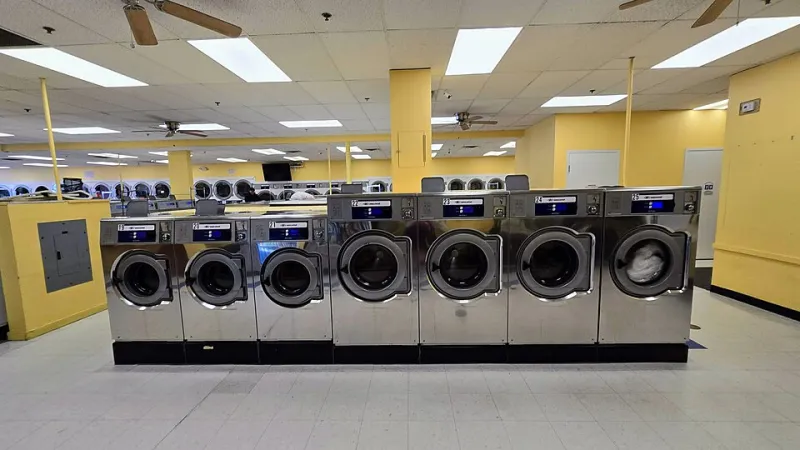
Photo: Baron Maddock, CC BY 4.0, via Wikimedia Commons
There is a particular kind of British cinema that costs a few pounds, smells faintly of conditioner and runs on a thirty-minute cycle. It is the launderette. You go in with a bag of damp towels and come out with a story idea, if you are paying attention. The machines are the screens, the other customers are the cast, and the whole thing already has a beginning, a middle and an end. You just have to press start.
This is not about being nosy. It is about being curious in a way that respects the unwritten rules of shared spaces. Think of yourself as a quiet location scout, not a documentary crew. Your job is to notice, invent and keep it to yourself until you get home.
The unlikely cinema at the end of the high street
Most entertainment is designed to grab you. A launderette does the opposite. It offers a row of portholes, a plastic chair, a noticeboard held together by ancient Blu Tack and the gentle thump of a drum. That low-stimulation setting is perfect for imagination because your brain has room to fill in the gaps.
A washing machine is also a natural screen. It is square, lit from within, and full of movement. The colours of the clothes become a cast list. A red sock is a hothead. A grey hoodie is the weary detective. A single tea towel is the comic relief. You do not need dialogue to start a scene — you just need a spin cycle and a willingness to ask what happens next.
Watch like a filmmaker, not a weirdo
Etiquette matters. A launderette is a practical place, and nobody wants to feel like a plot device while they are separating their lights from their darks. So keep your observation light and your staring minimal. Here are a few polite ways in:
- Use reflections. The front of a machine, a window or a glossy poster gives you a soft-focus view without direct eye contact.
- Look at objects, not people. Shoes, bags, laundry labels, umbrellas and the book someone has brought but will not read. Objects are fair game. People are not a display.
- Borrow from peripheral vision. Notice the shape of a scene rather than the details of a stranger. The mood of a room is enough.
- Invent from what is already there. A lost glove, a coin on the floor, a vending machine that only sells one flavour. These are prompts, not people.
- Keep it inner. The story stays in your head or your notes app. No photographs, no commentary, no pointing.
Your wash is a three-act structure
A wash cycle is almost suspiciously well-made. It gives you a ready-made storyboard for a sixty-second movie.
Act I: The load. Someone arrives with a problem. The bag is too heavy, the machine is full, the change machine is having a moment. This is your setup. Who are they? What do they want? What is the small obstacle in their way?
Act II: The wash. Things get complicated. The drum turns, the suds rise, the timer counts down. Maybe a sock goes missing. Maybe two strangers are stuck sharing a bench. Maybe the machine with the dodgy door starts making a noise like a disappointed kettle. This is where your story gets its middle — the bit where nothing is resolved and everything is slightly damp.
Act III: The spin and the fold. The cycle ends. The door opens. The clothes are warm. Someone folds a towel into a perfect rectangle and the scene closes. This is your ending, and it does not need to be dramatic. A small moment of order after a small moment of chaos is very satisfying in sixty seconds.
Five tiny pitches from the spin cycle
If you need a starting point, borrow one of these. Each one is designed to play out in about a minute — roughly the time it takes to move a load from washer to dryer.
- The Last Pod. A lone customer has a full bag and no change. The only working machine is the one with the cracked door and a reputation. The story is whether they risk it or walk home with wet washing. The ending is the sound of the first spin.
- Separation Anxiety. Two loads get mixed by accident: one sensible, one chaotic. The owners are not in the room. The clothes have to sort themselves out. It is a workplace comedy set entirely in a drum.
- The Rinse Cycle Whisperer. A regular customer swears machine four gives advice if you listen closely enough. The advice is always mundane — use less powder, check your pockets — but it is never wrong. Today it says something unexpected.
- Service Wash. The attendant has seen every story on the street pass through the machines. A new customer arrives with a mysterious stain and a badly folded map. The attendant recognises the map. Cue one minute of quiet suspense.
- The Sock That Came Back. A sock goes missing in the wash, as socks do. The next week, it returns in someone else's load, slightly changed. It has a tan line. It has a story. Nobody knows how to ask about it.
The fold is the credits
When the cycle ends, do not rush off. The folding is the credits sequence. Watch how people handle their clothes: brisk and efficient, vague and hopeful, or carefully colour-coordinated. A person who folds a fitted sheet in public is a character. A person who stuffs everything into one bag is a different genre entirely.
You can also use the walk home as a post-credits scene. What happens after the launderette? Does the red sock escape? Does the lost glove find its owner? Does the advice from machine four come true? You do not need to write it down unless you want to. The point is to let a small, ordinary place do what it has always done: give your imagination somewhere to spin.
Your sixty-second challenge
The next time you are waiting for a wash, set a timer for one minute. Choose one object in the room — a basket, a coin, a plastic chair, a lonely dryer — and invent a story that begins and ends before the timer buzzes. Do not worry about plot holes. Do not worry about whether it makes sense. Just let the drum turn and see what comes out in the rinse.
One minute is enough. A launderette is a multiplex if you look at it the right way.